Burst Pipe Repair
Grey pipe fittings, rusted galvanised, split flexi hoses and broken lines under the lawn. Water off, leak found, repair quoted first.
Read More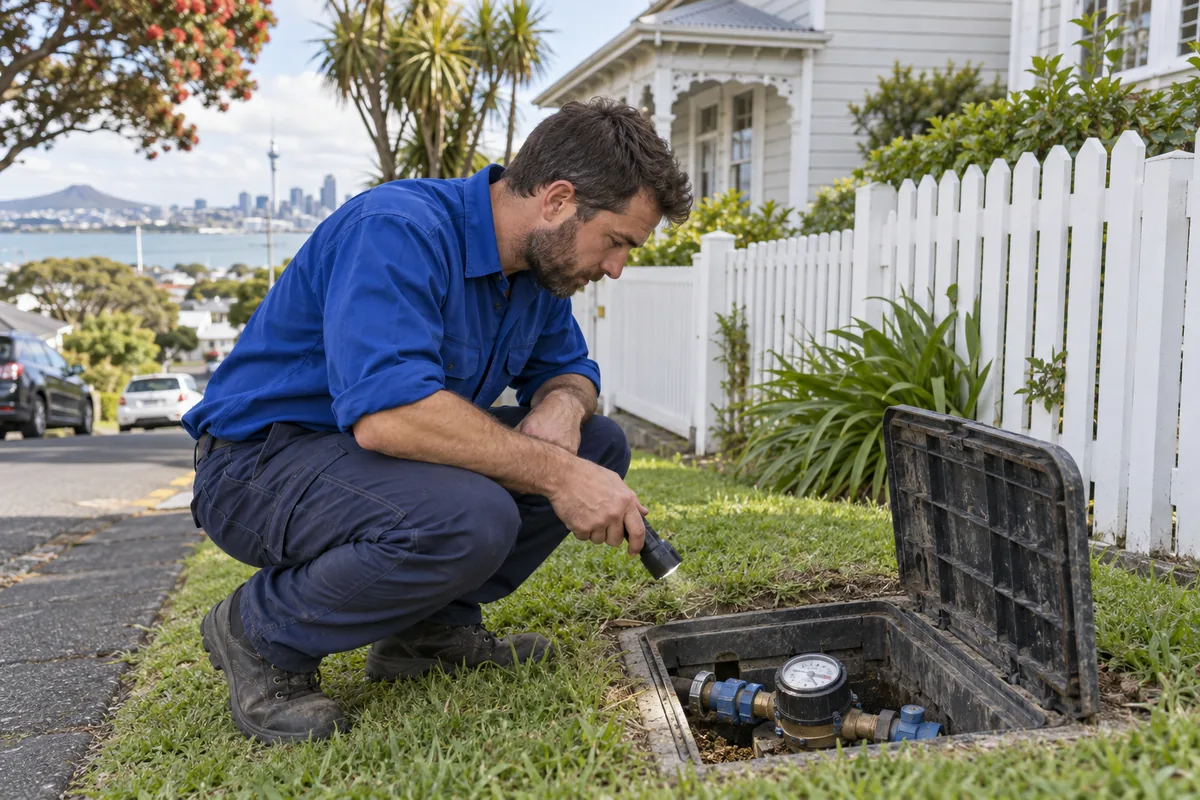
Burst pipes, leaking apartments, blocked drains and cylinder failures from Devonport and Takapuna to Glenfield, Albany and Browns Bay.
The North Shore covers Takapuna, Devonport, Milford, Northcote, Birkenhead, Glenfield, Albany and Browns Bay, from the harbour edge at Devonport north to Albany and the East Coast Bays. It holds some of Auckland's oldest villas on Northcote Point, Birkenhead and the Devonport peninsula, post-war state houses in Northcote, 1960s to 1980s suburbia across Glenfield and the Bays, 1990s and 2000s plaster homes around Albany, and a growing number of apartments in Takapuna and Albany. The Wairau Valley and Milford flooded badly in January 2023, and Waitematā clay slopes keep drains moving year round.
The North Shore has almost every Auckland housing era in a small area. Devonport, Northcote Point and Birkenhead hold villas and bungalows from before the Second World War, many still with galvanised water pipe somewhere in the walls, earthenware drains and a low-pressure copper cylinder fed by a header tank in the ceiling. Northcote's state houses from the 1940s and 1950s share those old materials, and many have been replaced or subdivided, leaving new homes connected to old drains.
Glenfield, Browns Bay and the rest of the East Coast Bays filled up from the 1960s to the 1980s with weatherboard and brick-and-tile homes on copper, and homes built through the 1980s and 1990s often still have polybutylene grey pipe. Albany and the infill around the Bays include a lot of 1990s and 2000s plaster homes, and Takapuna and Albany now have apartment buildings where one burst flexi hose can affect several floors.
The 27 January 2023 floods hit the Shore hard. The Wairau Valley and the streets around Milford and the Wairau Creek went under, and gully traps across the area overflowed as stormwater and wastewater lines were overloaded. Low-lying streets near estuaries and creeks remain the first to struggle in a downpour, so a gully trap lifting in heavy rain is one of the most common storm calls on the Shore.
Away from the flats, the Shore is ridges and gullies of Waitematā clay. Drain lines that run down steep sections in Birkenhead, Glenfield and the Bays shift as the clay swells and shrinks, and after long wet spells a small slip can crack or pull apart a line entirely. Cliff-top properties along the bays often have stormwater pipes discharging down the bank, and a broken one can make erosion worse, so it is worth getting it looked at promptly.
In Takapuna and Albany apartments, the typical emergency is water coming through a ceiling from the unit above. It is usually a flexi hose under a vanity, sink or toilet, a dishwasher connection, or a leaking shower. Tell the building manager or body corporate as well as the plumber, because access to the unit above and to shared valves often goes through them.
Plaster homes from the 1990s and early 2000s need particular care. Water getting into the framing is not always a plumbing leak, but a leaking shower, a failed flexi hose or a pinhole in a pipe inside the wall makes existing damage worse fast. If your water meter is turning with every tap off, or a wall is damp with no obvious source, leak detection finds the cause with as little opening up as possible.
Turn the water off at the toby, the box at the front boundary that holds the meter and stop valve. In apartments there is usually an isolation valve inside the unit, often in the laundry, under the kitchen sink or in a cupboard near the cylinder; if you cannot find it, ask the building manager. Switch the cylinder off at the switchboard, move valuables away from the water and put towels or a bucket under the drip. If a ceiling is bulging with water, keep people out from under it and turn off power to that area at the switchboard.
For an overflowing drain, stop using water in the house. If the smell of gas is strong, use no switches or flames, open the doors, turn the gas off at the meter or bottle if it is safe, get outside and ring 111. Take photos of the damage as you go, because photos and a written report help with an insurance claim.
You ring and explain what is happening. You are given an honest arrival time on the phone, and it accounts for how Shore traffic behaves: the Harbour Bridge and SH1 at peak, Onewa Road into Northcote and Birkenhead, Lake Road as the single main road down to Devonport, and East Coast Road through the Bays. The call-out and hourly rate are explained before anyone is dispatched.
On arrival the plumber makes the property safe, finds the cause and quotes the repair before work starts, so there is no surprise at the end. Any authorised plumber carries a PGDB photo ID card, and you can check the name on the Plumbers, Gasfitters and Drainlayers Board public register if you want to be sure.
The North Shore is a peninsula of bays, gullies and ridges joined to the city by the Auckland Harbour Bridge and to the west by SH18. The ground is mostly Waitematā clay, with volcanic pockets around Lake Pupuke and the Devonport cones of North Head and Mt Victoria, and soft sediments along the estuaries at Shoal Bay and the Wairau. The oldest homes are the villas and bungalows of Devonport, Northcote Point and Birkenhead, many with low-pressure cylinders and header tanks. Northcote has a large stock of state houses now being redeveloped, Glenfield and the Bays are mostly 1960s to 1980s, and Albany grew through the 1990s and 2000s plaster era before the recent apartments. Takapuna is the Shore's densest centre. SH1, Onewa Road, Lake Road and East Coast Road are the main routes.
Grey pipe fittings, rusted galvanised, split flexi hoses and broken lines under the lawn. Water off, leak found, repair quoted first.
Read MoreA spinning meter, a damp wall or a high water bill. The hidden leak is found with minimal damage, explained, and quoted before repair.
Read MoreOverflowing gully traps, sewage backing up, blocked downpipes and stormwater drains after heavy rain, found and fixed across Auckland.
Read MoreNo hot water, a leaking cylinder or a relief valve that will not stop running. Diagnosed, made safe and repaired or replaced, quoted first.
Read MoreTell us what is leaking, blocked or not working and which suburb you are in. You are talked through making it safe first.
Turn the water off at the toby or the isolation valve, and the power off if water is near wiring, while help is arranged.
The call-out and hourly rate are explained before anyone is dispatched, and you are given an honest arrival time.
The plumber finds the cause, quotes the repair before work starts, and fixes it or makes it safe until parts arrive.
The system is tested with the water back on, and you get photos and a written note of what was found and done.
Turn it off at the toby, then get a licensed Auckland plumber on the way. The rate is explained before anyone is dispatched.