A hidden water leak does not flood the house in an hour. It shows up slowly as a water bill that has crept up, a meter that keeps turning when every tap is off, a stain spreading across a ceiling, or carpet that is always slightly damp in one corner. Left alone, it rots framing, feeds mould and can undermine floors. Leak detection is about finding exactly where the water is going with as little damage to the house as possible, and then fixing it.
Start with the meter test
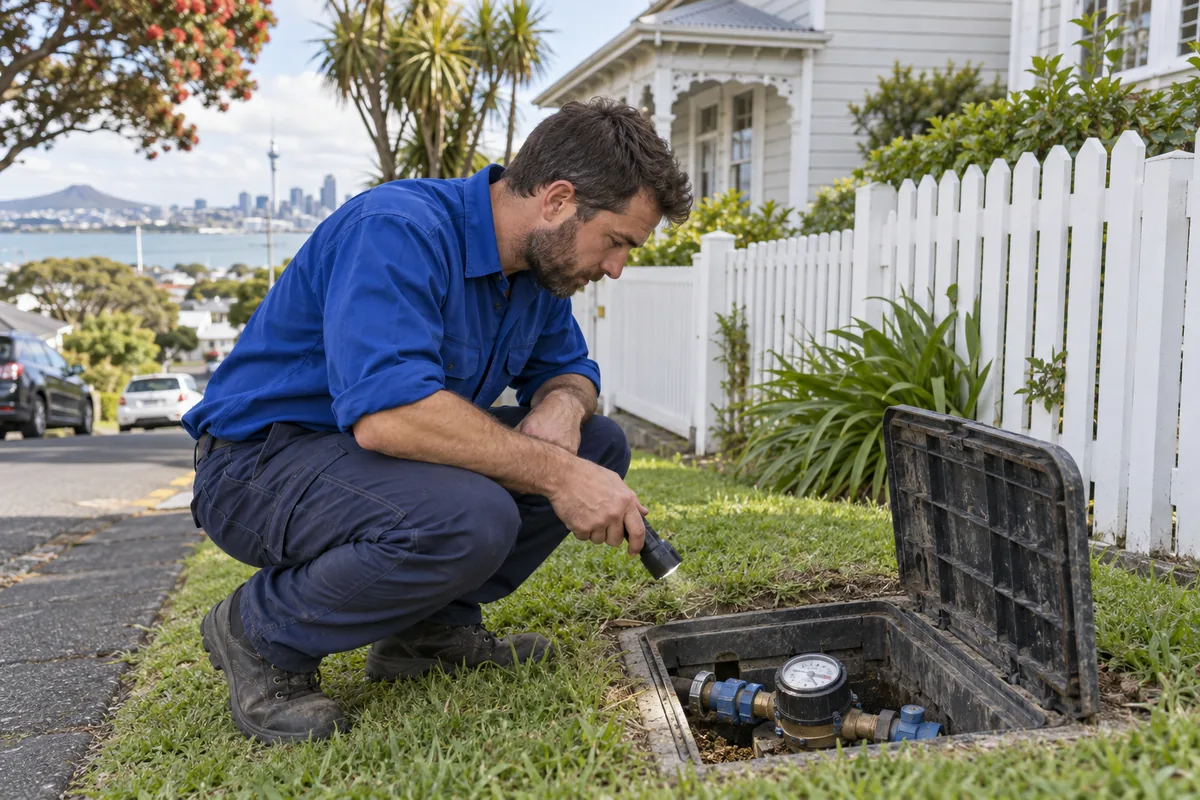
Before anyone opens a wall, confirm there is a leak. Turn off every tap and water-using appliance, including the dishwasher, washing machine, irrigation and any pool top-up. Then lift the lid of the toby, the small box at the front boundary in the berm or footpath, and look at the Watercare meter. If the dial or indicator is moving with nothing running, water is escaping somewhere on your side of the meter. Take a reading, wait an hour or two without using water, and read it again.
That test also answers the question of responsibility. Watercare owns the public network and the meter. Everything on the property side of the meter, including the underground service to the house and all the pipes inside, is the owner’s. A leak at the meter or in the street is reported to Watercare.
Where hidden leaks come from in Auckland homes
Polybutylene grey pipe
Grey pipe was widely used in New Zealand homes from the 1980s into the early 2000s, and its fittings are prone to failure. Not every failure is a sudden burst. Some fittings weep inside a wall for weeks before anyone notices. The polybutylene grey pipe guide explains how to recognise it.
Underground services on moving ground
On the North Shore and in West Auckland, Waitematā clay swells and shrinks with the seasons and can move on slopes after heavy rain. Properties on the bush-clad slopes of Titirangi and Glen Eden, and on sloping sections in Birkenhead and Glenfield, see this often. The movement cracks rigid pipe between the toby and the house, and old galvanised services in villa and state house suburbs such as Remuera, Epsom and Mount Albert simply rust through underground.
Showers, flexi hoses and apartments
In townhouses and apartments, the usual hidden leaks are a shower weeping behind the tiles, a flexi hose seeping in a vanity cupboard, or a fitting leaking between floors. In a body corporate building the leak often appears in someone else’s unit first.
Leaky building or leaking pipe?
Plaster monolithic homes from the 1990s and early 2000s in Albany, Botany Downs, Dannemora and parts of Flat Bush and West Harbour are known for weathertightness problems. Not every damp wall is a plumbing leak, and the first useful step is to rule the pipework in or out. If the plumbing tests sound, a building surveyor is the right next call.
How the leak is found
Pressure testing
The hot and cold lines are isolated and tested separately. If one holds pressure and the other drops, the search area halves immediately. The underground service is tested separately from the house plumbing.
Moisture readings and thermal imaging
Moisture meters show how wet wall linings, floors and ceilings are and in which direction the water is spreading. A thermal camera picks up temperature differences behind linings, which is especially useful for hot water leaks.
Acoustic and tracer methods
For underground pipes, listening equipment picks up the sound of escaping water, and tracer methods can pinpoint the spot. The result is a targeted opening rather than a trench across the lawn.
Repair and report
Once the leak is found, you are shown where it is and what caused it, and the repair is quoted before work starts. Small repairs are usually done on the same visit. Larger jobs, such as replacing an underground service or a run of grey pipe, are quoted separately. Photos and a written report help with an insurance or body corporate claim. If a leak turns into a burst, burst pipe repair covers what happens next.
When it is an emergency
A slow rise in the water bill can wait for a daytime booking. Water coming through a ceiling, a bulging ceiling, water near electrics, or a meter spinning fast is an emergency: turn the water off at the toby and call the 24 hour emergency plumber.